Published • loading... • Updated
Deportees Who Refused to Exit a US Flight in Liberia Are Sent to Equatorial Guinea
Five migrants refused to leave a deportation flight to Liberia and were sent onward to Equatorial Guinea, where they remain detained.
- On Thursday, six migrants deported from the United States to Liberia refused to disembark, prompting authorities to send them to Equatorial Guinea instead; the group included four Cubans, a Brazilian, and a Cameroonian.
- Under 'third-country' agreements, the Trump administration has deported thousands of people to two dozen countries as part of its immigration crackdown, citing legal grounds for the practice.
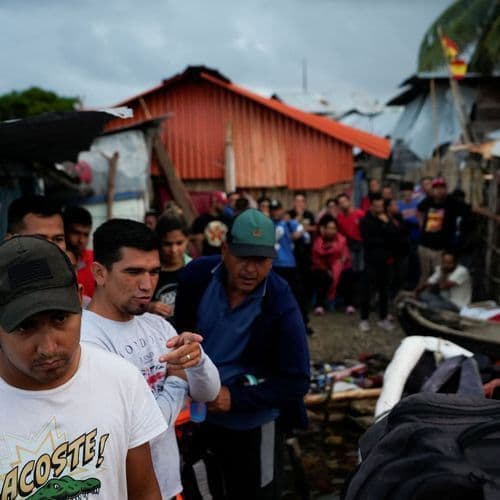
- Refusing to leave the aircraft, the group stated Liberia was "not their country" and feared danger; upon arrival in Malabo, some were reportedly in chains, detained at a hotel under a $7.5 million deal with President Teodoro Obiang Nguema Mbasogo.
- Yoon reported the six are held with around 40 other migrants in a hotel lacking medical staff, where conditions have worsened with food withheld and guards accused of threatening, beating, and choking detainees.
- The Department of Homeland Security stated the migrants were "deported to a safe third country," yet former ICE adviser Claire Trickler-McNulty called the move "highly unusual," noting that group refusal followed by onward diversion is unprecedented.
Insights by Ground AI
24 Articles
24 Articles
 Associated Press News
+21 Reposted by 21 other sources


Deportees who refused to exit a US flight in Liberia are sent to Equatorial Guinea
Six people deported by the U.S. to Liberia last week resisted getting off the plane. Instead, they were sent to Equatorial Guinea, according to a person on the plane and a lawyer.
·New York, United States
Read Full Article
Five Men Deported by US Refuse to Disembark Plane
The US ran into what appears to be a first-of-its-kind snag in its aggressive deportation push: Five migrants flown from the US to Liberia refused to disembark from their plane, reports the New York Times . The group—identified by lawyers as four Cubans, a Brazilian, and a Cameroonian—were then...
·Miami, United States
Read Full Article
“We feel kidnapped because we can’t get out of here. We don’t know what to do,” says one of them, Carlos Rodríguez.
Coverage Details
Total News Sources24
Leaning Left7Leaning Right0Center16Last UpdatedBias Distribution70% Center
Bias Distribution
- 70% of the sources are Center
70% Center
L 30%
C 70%


Factuality
To view factuality data please Upgrade to Premium