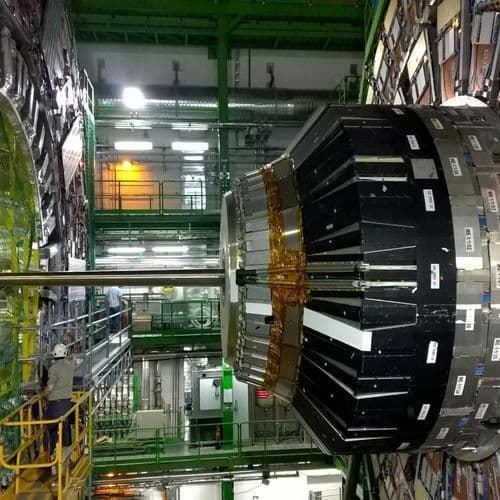
CERN's 'Mini Big Bang' Helps Scientists Study the Universe's Earliest Moments
 This story is only covered by news sources that have yet to be evaluated by the independent media monitoring agencies we use to assess the quality and reliability of news outlets on our platform. Learn more here.
4 Articles
4 Articles


Experiment used LHC to recreate the state of matter immediately after the Big Bang, with lighter elements than thought possible Scientists create mini-Big Bang in laboratory (contains clickbait)

Scientists have collided light nuclei of oxygen and neon — and have managed to replicate signs of the primordial matter that existed in the first moments of the Universe. After all, much smaller collisions are needed than was thought to create this extreme state. In the first moments of the Universe, matter did not exist as we know it today. It was 13.8 billion years ago, more than million less million. About a millionth of a second after the Bi…

Researchers at the Niels Bohr Institute in the Netherlands have succeeded in using oxygen-16 and neon-20, which are a fraction of the size of lead, and have caused them to collide with each other at almost the speed of light According to reports, European scientists have recreated a “small” version of how the universe could have been right after the Big Bang, using two of the smallest atoms that exist.
Coverage Details
Bias Distribution
- 100% of the sources are Center


Factuality
To view factuality data please Upgrade to Premium