Study: Milky Way Flipped 90° After Ancient Galaxy Crash
Simulations suggest an ancient merger slowly reoriented the galaxy’s disk and left its stellar halo rotating far more slowly than expected.
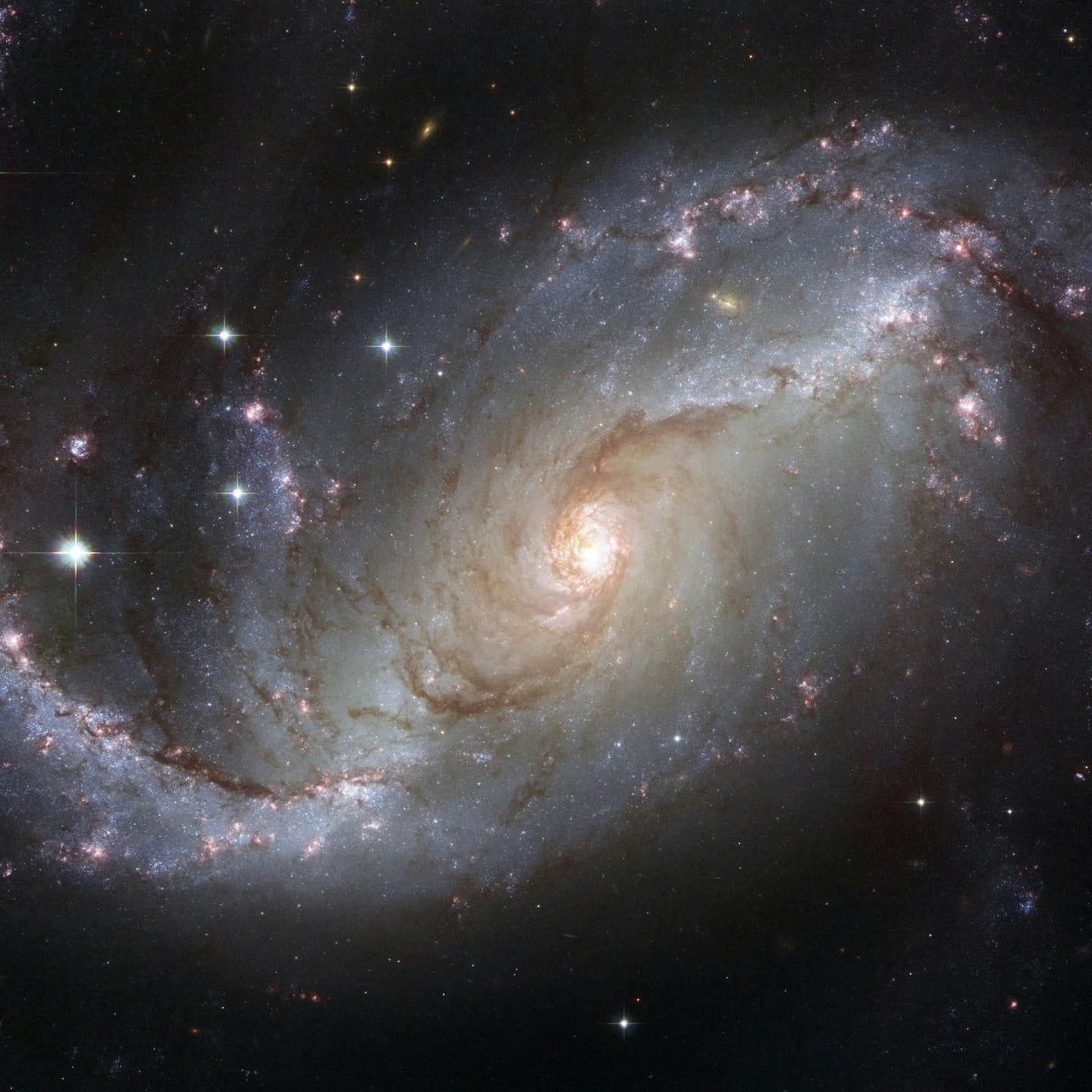
- Astronomer Kirill Batrakov of Durham University presented findings at the 2026 Royal Astronomical Society's National Astronomy Meeting showing the Milky Way's disk may have gradually tipped onto its side over billions of years.
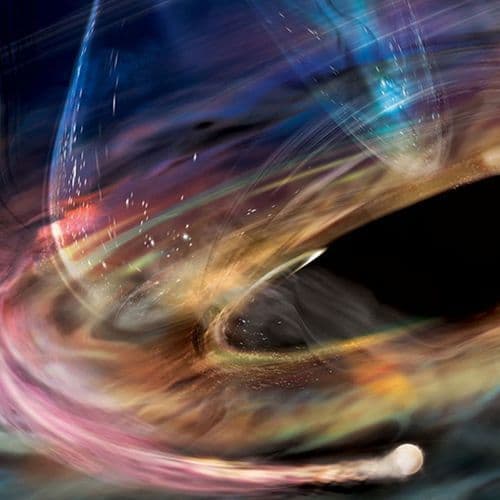
- About 10 or 11 billion years ago, the massive dwarf galaxy Gaia-Sausage-Enceladus smashed into the Milky Way, serving as the most significant event in our galaxy's early history and reshaping it fundamentally.
- Batrakov defined the 'disk flip' as a change in orientation by more than 90 degrees, which helps explain why the sparse stellar halo rotates more slowly than expected for the galaxy's mass.
- Using Auriga simulations of 25 galaxies, researchers linked slow-rotating haloes to major mergers; the Chinese Academy of Sciences independently found the dark matter halo oriented almost perpendicular to the stellar disk.
- If observers on Earth could witness the process, the night sky would change as constellations shifted; understanding the Milky Way provides a 'testbed' for studying other galaxies.
32 Articles
32 Articles

Our Milky Way galaxy appears to have flipped 90 degrees long ago. But why?
The Milky Way's spiral disk may have flipped over by 90 degrees, in turn altering the solar system's orbit around the center of the galaxy.Spiral galaxies such as the Milky Way have two main, visible, structural components: a disk that encapsulates most of its stars, gas and the central black hole, and a more diffuse halo of older stars that encapsulates the disk.However, the Milky Way's stellar halo has always been a bit of an oddity. The Europ…

Looking Inwards on an Evolving Milky Way
Title: Watching Our Galaxy Grow Up: The Mass and Color Evolution of the Milky Way Authors: Gail Zasowski, Julie Imig, & Hayley Coluccio First Author’s Institution: Department of Astronomy, University of Utah, E2108 Stewart Building 270 S 1400 E, Salt Lake City, UT 84112 Status: Published in The Open Journal of Astrophysics (2025 July 23) [open access] How Do You Observe Something From the Inside? Figure 1: An artist’s interpretation of the Mil…
 Universe Today
 Knowridge Science Report
The Milky Way Flipped its Disk Billions of Years Ago
The Milky Way has two disks, the thin disk where most of the stars dwell, and the thick disk, populated by much older stars. The ESA's Gaia mission showed us that the thick disk rotates more slowly than the thin disk. The culprit, according to powerful simulations, was a disk flip in the MW's past, driven by a merger.

The current state of the Milky Way may have been shaped by a massive galaxy collision 10 billion years ago

Our Milky Way Galaxy Likely Underwent Disk Flip after Ancient Galactic Collision: Study
A head-on collision with another galaxy billions of years ago may have dramatically reoriented the Milky Way’s disk, according to new supercomputer simulations that reveal how violent mergers can leave spiral galaxies looking surprisingly normal today. The post Our Milky Way Galaxy Likely Underwent Disk Flip after Ancient Galactic Collision: Study appeared first on Sci.News: Breaking Science News.

Our galaxy flipped after a collision, say astronomers
Our galaxy flipped after a collision with a dwarf galaxy 10 billion years ago, changing the Milky Way's evolution, new simulations suggest. The post Our galaxy flipped after a collision, say astronomers first appeared on EarthSky.
Coverage Details
Bias Distribution
- 62% of the sources are Center


Factuality
To view factuality data please Upgrade to Premium