Nepal Floods: Khalte Residents Knew the River Could Take Their Camp – and Then It Did
Rescuers are searching for more than 4,200 missing people as roads, power and communications remain cut and evacuated families need relief supplies.
- Massive flash floods and mudslides struck the Nepal-China border on August 26, killing more than 1,200 people and leaving over 4,700 others unaccounted for across both nations.
- The settlement of Khalte, housing 257 families displaced by the 2015 earthquake, was completely destroyed despite a 2018 National Reconstruction Authority assessment declaring the site unsafe due to flooding risk.
- According to the Internal Displacement Monitoring Centre, 83 million people were internally displaced globally at the end of 2025, with 45 million displaced by climate change effects alone.
- Nepali Prime Minister Balendra Shah told parliament on Wednesday, "The time has come for us to strongly present to the international community the disasters we are facing because of climate change."
- Nepal produces just 0.1% of global greenhouse gas emissions yet faces extreme climate risks, prompting Nepali Foreign Minister Shisir Khanal to indicate the nation will seek compensation from China, India, and the US.
20 Articles
20 Articles
 Il Tempo


Rasuwa, 3 set. (askanews) - The aerial images taken from a helicopter show the district of Rasuwa, Nepal, the first and most severely affected by the devastating sudden floods of August 26 that wiped out villages and houses more than a week ago. There remains a huge strip of mud and land, some house scattered on the sides. According to the last budget between Nepal and China the dead would be over 1,200 while almost 5,000 people are scattered.

Nepal floods: Khalte residents knew the river could take their camp – and then it did
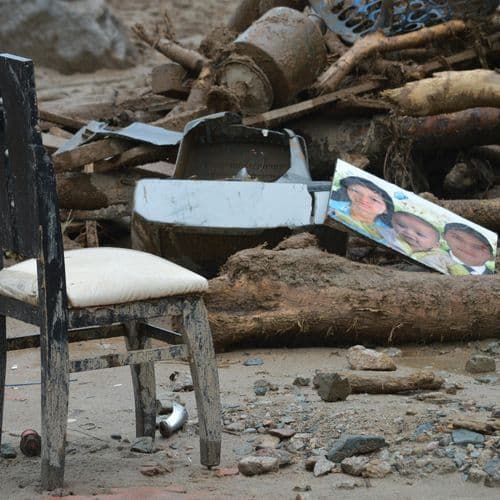
Khalte, a settlement close to the bank of the Trishuli River in northern Nepal, was completely destroyed in the flash flooding of late August. Khalte housed around 257 families who had been displaced by a previous disaster, when Nepal was rocked by a 7.8-magnitude earthquake in 2015. I spent time working with families there in September 2019, as part of a research project looking at how renewable energy might improve their lives. This community …

On August 26, 2026, a sudden flood of the river Bhote Koshi, caused by a collapse of ice and rock in the area on the border between Nepal and Tibet, overwhelms the district of Rasuwa in a few minutes. The wave of water, mud and debris takes away lives, roads and villages. The devastation in the affected areas makes it difficult for the rescue to arrive. The victims' balance continues to grow, reaching, seven days later, more than 1,200 dead and …


Satellite data detected abnormal movements and accelerations of glaciers and rocks prior to the massive floods in Nepal last month. Experts viewed this as a sign of structural instability and suggested the importance of establishing an AI-based system capable of continuously monitoring disasters in extensive mountainous regions.

Nepal Floods: Over 1,200 Dead, Betrawati in Ruins as Trishuli Swells 20 Times
Catastrophic flash floods in Nepal have left more than 1,200 people dead, over 4,200 missing, and nearly 12,000 rescued. Addressing Parliament, the Prime Minister stated that Nepal never refused international assistance and thanked India and China for stepping up with rescue and relief operations. Search teams continue operations inside hydropower tunnels as recovery efforts begin. Ground reports reveal complete devastation in Betrawati, the largest town at the foothills of Rasuwa, which was swept away after a glacial collapse. The Trishuli river expanded from a 30-metre stream to over 600 metres, washing away houses, schools, temples, and bridges. Meanwhile, visuals from Dhunge Bazaar show certain structures surviving despite being submerged in 12 to 15 feet of mud, while surrounding areas were destroyed.
Coverage Details
Bias Distribution
- 62% of the sources lean Right


Factuality
To view factuality data please Upgrade to Premium