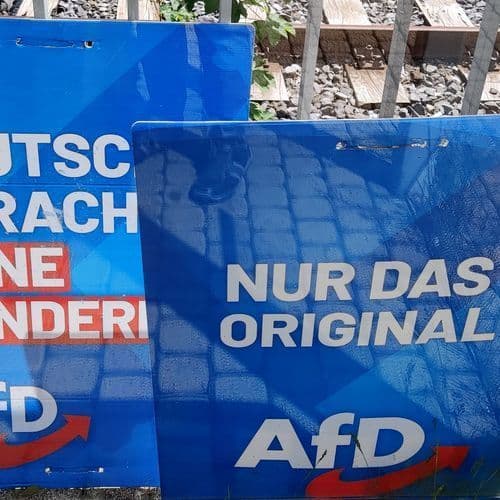
What AfD's Election Victory in Germany's Saxony-Anhalt Could Mean for Jewish Life
The party won 43.8% and more than doubled its vote share, while the CDU fell to 17.2% and lost about half its support.
- In a regional election west of Berlin, the AfD secured 43.8% of the vote, more than doubling its showing from five years ago. AfD Co-leader Alice Weidel declared the party has "received a very clear mandate to govern here."
- The Christian Democratic Union polled 17.2%, losing about half its support and winning 15 seats, while the Social Democrats, Greens, and Left Party each secured 9.3%, 8.9%, and 8.6%, winning eight seats apiece.
- General secretary Franziska Hoppermann called the outcome "a very difficult result for us," while Lead candidate Ulrich Siegmund needled Chancellor Friedrich Merz, saying he was a "very good campaigner for us."
- While Italian Deputy Prime Minister Matteo Salvini declared "another Europe is possible," Polish Prime Minister Donald Tusk wrote that "only idiots or traitors can rejoice at the triumph of the AfD," naming Konfederacja and PiS members.
- Weidel told reporters she expects early federal elections and the current chancellor to be replaced before Christmas, citing the party's platform of representing national interests over those of Ukraine or any other country.
42 Articles
42 Articles

Former Hungarian Prime Minister Viktor Orbán (Fidesz) congratulated the Alternative for Germany (AfD) party in Saxony-Anhalt. AfD co-chair Alice Weidel supported Orbán in the campaign for this year's parliamentary elections in Hungary, but Fidesz lost the election in a landslide.

What AfD's election victory in Germany's Saxony-Anhalt could mean for Jewish life
Siegmund faced criticism over his attitude toward Germany’s Nazi past. In a 2025 interview, he refused to answer whether he considered the Holocaust the most horrific crime in history.

In Austria, many have a strong opinion on the election victory of the AfD in Saxony-Anhalt. The KURIER has listened around in Vienna.

Analysis: AfD's victory reveals Europe's real delusion: the belief that there is a method that can make the radical right go away.

EADaily, 7 September 2026. The outcome of the Landtag (Regional Parliament) elections in the German Federal Land of Saxony-Anhalt gives rise to hope for a change of course in the FRG ' s energy policy, which should lead to the lifting of anti-Russian sanctions.

Coverage Details
Bias Distribution
- 36% of the sources lean Left, 36% of the sources lean Right


Factuality
To view factuality data please Upgrade to Premium