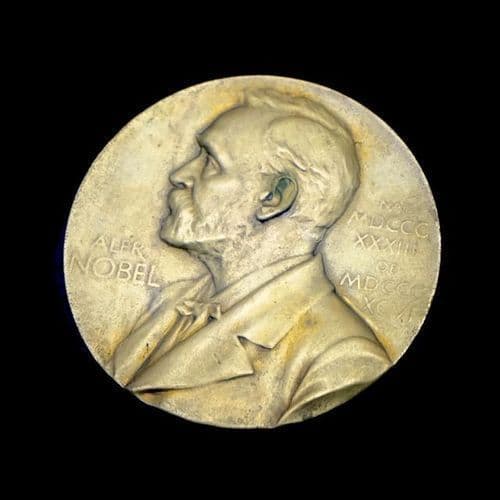
Nobel Prize in chemistry awarded to Henri Kagan and Kenso Soai
- On Wednesday, the Royal Swedish Academy of Sciences awarded the 2026 Nobel Prize in Chemistry to Henri B. Kagan and Kenso Soai for discovering non-linear effects and autocatalysis in asymmetric organic synthesis.
- Nobel Committee chair Heiner Linke explained homochirality—where life uses only one version of mirror-image molecules—as a fundamental mystery that had puzzled chemists for over a century.
- Kagan, 95, and 76-year-old Soai developed methods to drive reactions toward specific mirror-image molecules, with Soai creating the 'Soai reaction' to generate an excess of one form—a feat the committee called 'spectacular.'
- Pharmaceutical manufacturers now rely on these discoveries to selectively prepare specific mirror-image compounds, ensuring therapeutic efficacy while avoiding harmful side effects from incorrect molecular variants.
- The laureates share a 12 million Swedish kronor prize. The 2026 Nobel cycle continues with the literature laureate announcement on Thursday and the peace prize on Friday.
747 Articles
747 Articles

Henri Kagan and Kenso Soai are honored with the Nobel Prize in Chemistry for solving a hundred-year-old puzzle.


Life Is Asymmetric. The Scientists Who Figured Out Why Won the 2026 Nobel Prize in Chemistry
Henri Kagan and Kensō Soai designed chemical reactions producing only one of the two mirror-image forms of a molecule—an important finding for the synthesis of pharmaceuticals and other biological substances.

Pioneering molecular reaction duo win Nobel Prize in Chemistry
Henri Kagan and Kenso Soai were recognised for the discovery of non-linear effects and autocatalysis in asymmetric organic synthesis. Read more: Pioneering molecular reaction duo win Nobel Prize in Chemistry

The 2026 Nobel Prize in Chemistry honors discoveries that enable chemists to carry out homochiral chemical reactions.

French chemist Henri B. Kagan and Japanese scientist Kenso Soai have won the 2026 Nobel Prize in Chemistry. The award was given to them “for their discoveries of nonlinear effects and autocatalysis in asymmetric organic synthesis,” the Royal Swedish Academy of Sciences announced. Their research focuses on molecules that can exist in two mirror images. Like a left and right hand, these forms have the same chemical composition but are not complete…
Coverage Details
Bias Distribution
- 39% of the sources are Center


Factuality
To view factuality data please Upgrade to Premium